When to Reface vs Replace Your Kitchen Cabinets
A simple checklist to decide whether to reface or replace your cabinets, based on layout, box condition, budget, and style change.

Deciding between refacing and replacing cabinets doesn’t have to be complicated. A quick five-point checklist tells you which path your kitchen belongs on. Here’s the framework we use during every free consultation.
The five-point decision checklist
Run your kitchen through these five questions in order.
1. Is the layout working?
Walk your kitchen and ask honestly: does the current cabinet layout support how you cook? If yes → refacing is on the table. If no (cramped, awkward flow, missing storage, wrong sink location) → replacement.
2. Are the boxes structurally sound?
Open a cabinet door and look at the box itself. Check for:
- Water damage or swelling (especially under the sink and dishwasher)
- Warping in the sides or back
- Failing joints or separations
- Rot or soft spots
If everything looks solid → refacing candidate. If not → replacement.
3. Are you moving plumbing or electrical?
Are you adding a prep sink, moving the range, changing the dishwasher location, or adding new circuits for outlets, lighting, or appliances? If yes → replacement (the cabinets have to come out anyway). If no → refacing works.
4. What’s your budget priority?
Are you trying to maximize value for a fixed budget? Refacing saves 30-50% and often lets you spend more on counters, backsplash, or appliances. If maximum value matters → refacing wins. If you have budget flexibility and want maximum scope → replacement is on the table.
5. What’s your timeline?
Refacing wraps in 3-5 days on-site. Replacement takes weeks. If speed matters (hosting, resale, calendar constraint) → refacing. If time is flexible → either works.
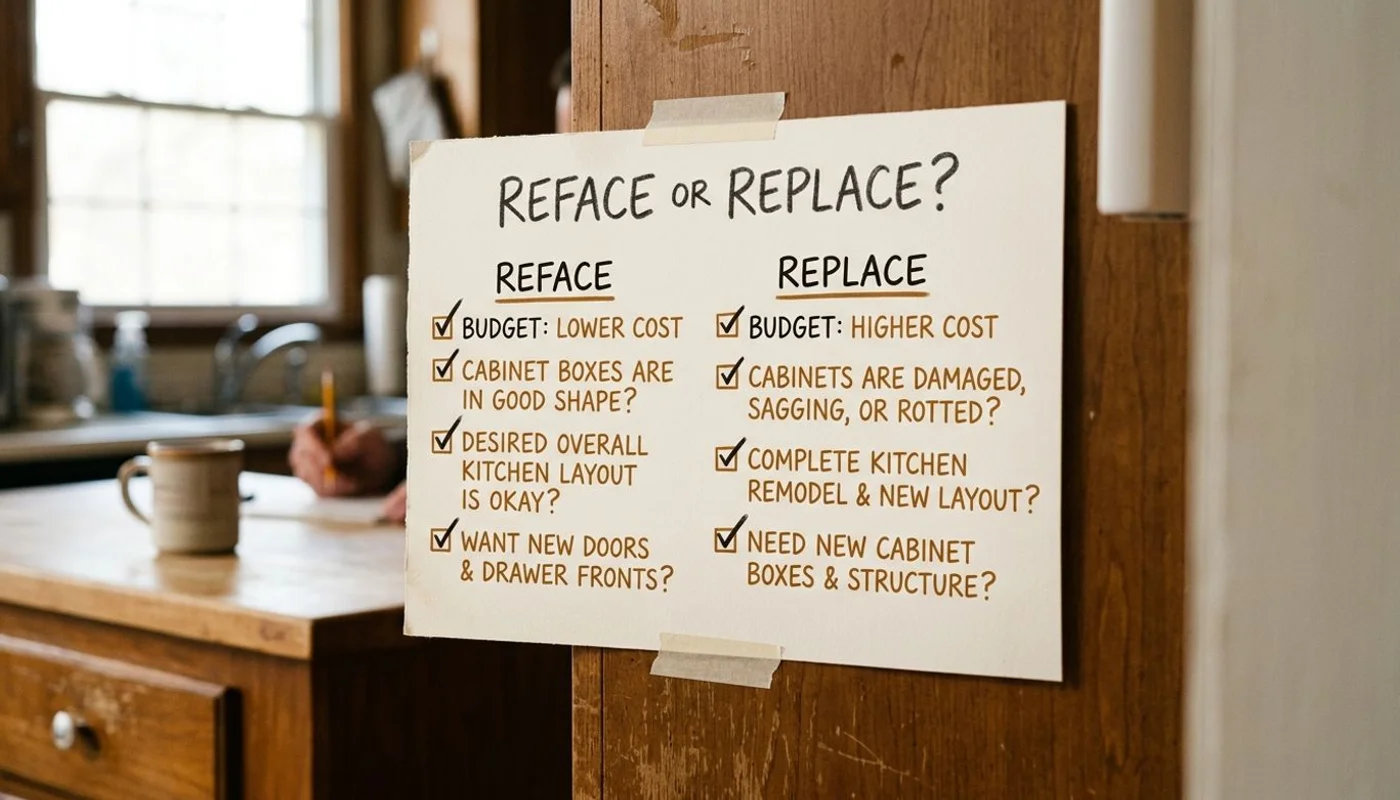
Clear “reface” scenarios
Reface when:
- Boxes are sound, layout works, you want a fresh look
- You want a cost-effective refresh before selling the home
- The current layout has good bones but the cabinet doors are dated
- You’re happy with your kitchen’s function but hate the appearance
- You want a fast, low-disruption update
Clear “replace” scenarios
Replace when:
- The layout doesn’t work for how you cook
- Boxes are water-damaged, warped, or rotting
- You’re changing the footprint (adding pantry, moving sink, expanding an island)
- You’re moving plumbing or electrical during the remodel
- Existing cabinet dimensions are wrong for your storage needs
- You want cabinets that go to the ceiling (raising short existing cabinets often means replacement)
The gray-area scenarios
Some kitchens don’t have a clear answer. Common gray-area cases:
- “Layout is mostly fine but one thing bugs me.” Sometimes a targeted change (removing a peninsula, replacing one cabinet with a pantry pull-out) can happen within a refacing project.
- “Boxes look OK but there’s one bad spot.” Some cabinets can be selectively replaced while others are refaced, blending the two approaches.
- “I like the current cabinets but they don’t match a newer addition.” Refacing can unify multiple cabinet runs into a cohesive look.
For gray-area kitchens, an in-person assessment resolves it fast. We routinely handle blended refacing/replacement projects where it makes sense.
The most common misconception
The most common misconception we hear: “Refacing must be lower quality since it’s cheaper.” Not true. Refacing saves cost by keeping components that don’t need to be replaced (the boxes). The new components — doors, drawer fronts, hinges, glides, hardware — are the same quality as new cabinets. When boxes are sound, refacing delivers cabinets that look and function as well as new ones.
Making the decision
If your five-point checklist points clearly one way, trust it. If you’re in gray area, book a free in-home consultation — we’ll assess your boxes, discuss your goals, and give you an honest recommendation. In some consultations, we recommend refacing to homeowners who came in expecting to replace. In others, we recommend replacement to save homeowners from a refacing job that wouldn’t have solved their actual problem.
For a fuller side-by-side, see our refacing vs replacement guide. And if refacing sounds right, our cabinet refacing service page has the full scope details.
Frequently Asked Questions
How do I know if my cabinets can be refaced? +
If the boxes are solid (no water damage, no warping, no failing joints) and you like the layout, refacing is a strong candidate. Any Central Ohio contractor doing an honest consultation can tell you within 15 minutes.
What are signs I need new cabinets? +
Water damage under a sink or dishwasher, warping in exterior box faces, failing joints, rot, layout you want to change, or a plan to move plumbing or electrical — any of these point to replacement.
Can you tell me which is right during the consultation? +
Yes. We assess box condition, discuss your layout goals, and give an honest recommendation. Sometimes we recommend refacing even when a homeowner came in expecting replacement — the savings can be meaningful.