Quartz vs Granite Countertops
Quartz vs granite compared on durability, maintenance, looks, heat and stain resistance, cost, and resale, plus which suits you.
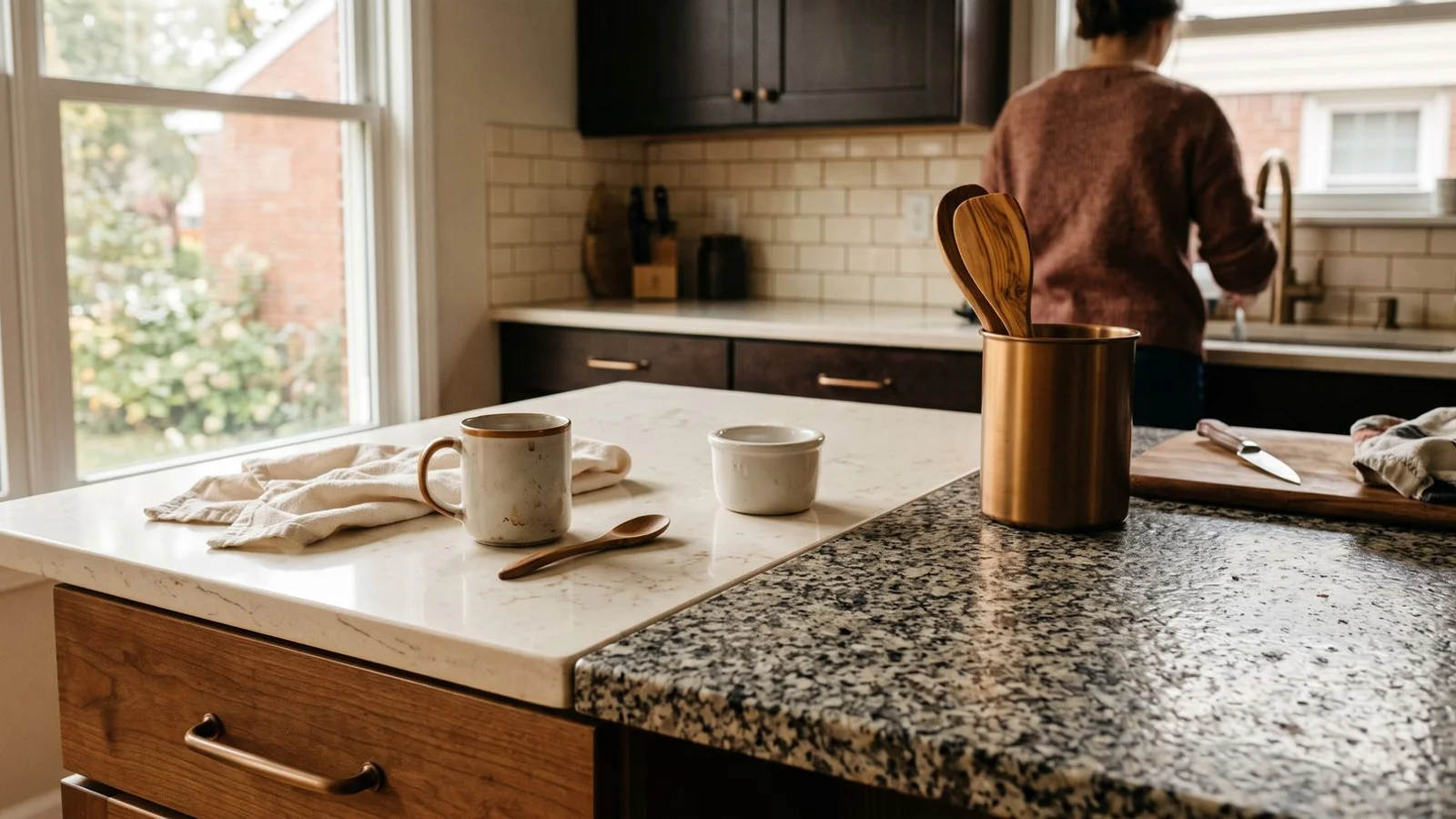
As the team at Columbus Kitchen Pros, we consistently see homeowners stalled by the same major choice during kitchen remodels.
Choosing between quartz vs granite countertops remains the biggest hurdle for projects across Central Ohio. Both options provide premium aesthetics and hold excellent value at resale.
Our team knows they solve everyday kitchen challenges in very different ways.
Here is the honest comparison to help you pick the right surface.
The one-line summary
Quartz is engineered, uniform, and effectively maintenance-free.
Granite is a natural stone that handles direct heat beautifully, though it requires annual sealing.
Our recommendation points to quartz for a sleek, low-maintenance modern space. Choose granite if you prefer organic character and do not mind basic upkeep.
Head-to-head: quartz vs granite countertops
Comparing these two premium materials side-by-side reveals clear functional differences. We break down the critical factors to help guide your investment.
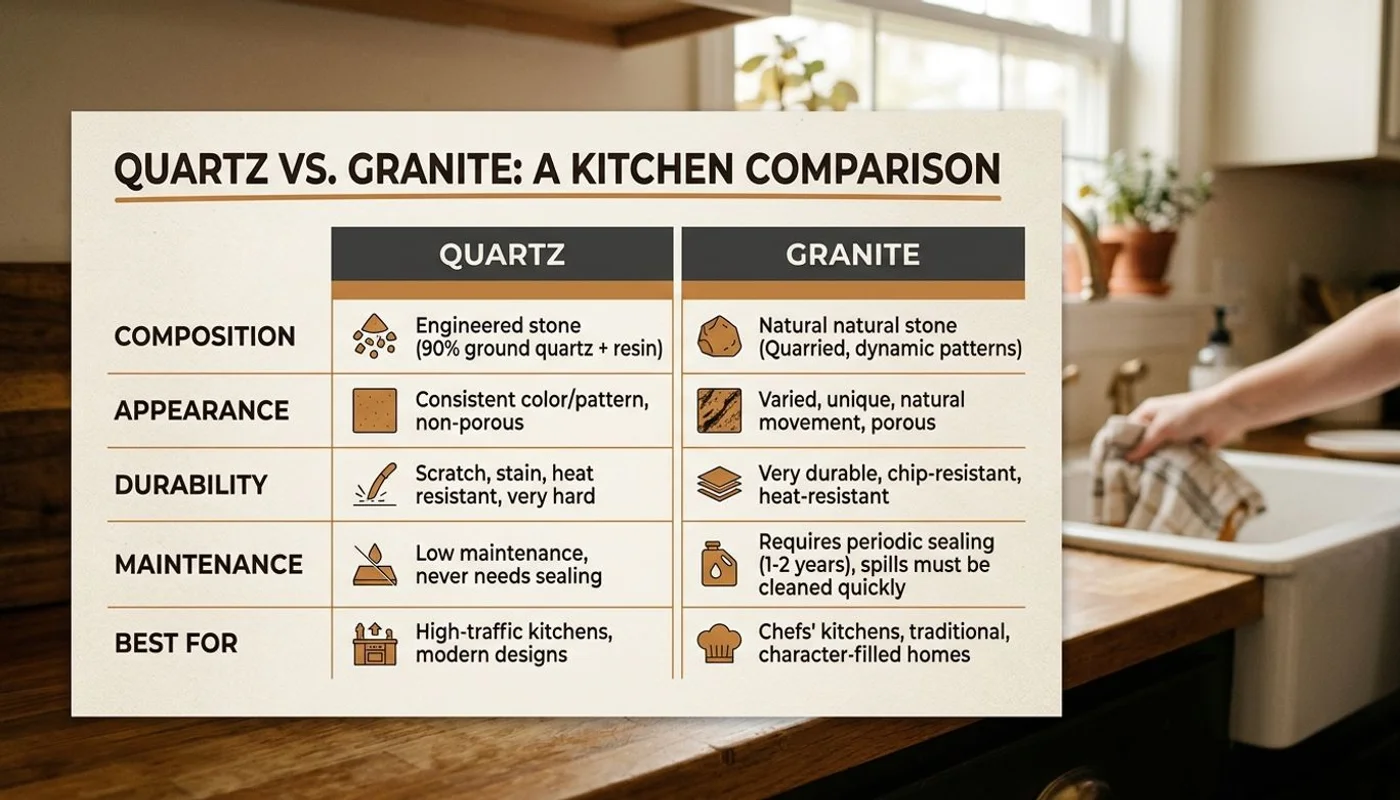
Look and Durability
Quartz provides highly controlled patterns, and manufacturers now offer convincing Calacatta marble styles in almost any color. Granite ensures every single slab is entirely unique. You get deep natural character with stones like Absolute Black, meaning no two kitchens will look exactly the same.
Both materials are extremely durable against daily wear. Our fabricators note that quartz resists chipping slightly better, while granite wins on heat tolerance.
Maintenance and Heat Resistance
Quartz requires essentially zero maintenance, meaning you simply wipe it clean without ever needing a specialized treatment. Granite requires an annual application of an impregnating stone sealer. This quick 15-minute wipe-on process prevents the porous stone from absorbing stains.
We always warn clients about the heat limits of engineered quartz. The surface is sensitive to sustained heat because the polymer resin binders can burn or discolor between 150 and 300 degrees Fahrenheit. Granite offers excellent heat resistance, allowing you to confidently place hot pans directly onto the natural stone.
Stain and Scratch Resistance
Quartz delivers excellent stain resistance right out of the gate. The non-porous manufacturing process means the material does not absorb spilled liquids. Granite performs very well against stains only when properly sealed, so you should wipe up heavy spills promptly just to be safe.
Both surfaces offer outstanding scratch resistance against typical kitchen tools. Our experts still recommend using cutting boards to protect your knives from dulling on the hard stone.
2026 Cost Comparison
Standard pricing metrics shifted slightly coming into 2026. We created this breakdown to reflect current US market rates for materials and professional installation.
| Material & Tier | Estimated 2026 Cost (Installed) |
|---|---|
| Standard Granite | $40 - $60 per sq. ft. |
| Premium/Exotic Granite | $150 - $300+ per sq. ft. |
| Standard Quartz | $60 - $90 per sq. ft. |
| Premium Quartz | $100 - $150+ per sq. ft. |
Basic granite often comes in slightly cheaper than standard quartz. Premium tiers for both materials overlap significantly in the high-end market.
Which suits your household
Your daily routines should dictate the final material choice.
Choose quartz if:
- You run a busy family kitchen with heavy daily traffic.
- You want zero maintenance without worrying about annual sealing schedules.
- You prefer modern, consistent looks like warm white marble designs.
- You need strict stain resistance for wine, coffee, or acidic tomato sauces.
- You are perfectly happy using a trivet for hot pans.
Choose granite if:
- You cook constantly and want to place hot pans directly on the counter.
- You love the unique character and natural depth of quarried stone.
- You feel comfortable applying a wipe-on sealer once a year.
- You want a premium, character-rich focal point like a Level 4 exotic slab.
- You prefer natural materials over engineered composites.
The heat trade-off
The single biggest practical difference between these options is heat tolerance. Granite safely handles hot pans resting directly on its surface. Quartz simply cannot handle that level of direct thermal shock.
Our technicians see scorch marks happen when a pan fresh from a 400-degree oven hits a quartz counter. The polymer resins that make the material non-porous begin to melt and burn between 150 and 300 degrees Fahrenheit.
The polymer resins in engineered quartz provide incredible stain resistance, but they will begin to scorch and discolor at temperatures between 150 and 300 degrees Fahrenheit.
Granite is the obvious winner if you routinely slide hot skillets off the stove without a hot pad. Quartz usually wins out if you can train yourself to always use a silicone trivet. You get the benefits of zero sealing, stronger stain resistance, and uniform patterns in exchange for that one habit.
The look trade-off
Aesthetic preference drives the other major difference in this comparison. Granite slabs are cut straight from the earth. Every single natural piece features one-of-a-kind veining, mineral deposits, and color variations.
Our custom clients often select granite specifically to have a completely unique kitchen island. Quartz slabs, conversely, are manufactured in a factory setting. You can order the exact same look repeatedly, allowing for perfect seam matching, but you lose that wild natural character.
Current 2026 design trends show clear preferences for both materials:
- Quartz: High demand for warm whites and creamy beige styles for minimalist designs.
- Granite: Strong preference for dramatic, high-movement exotic slabs for statement islands.
Some homeowners prefer the precise consistency of quartz for modern designs, while others demand natural stone. Neither approach is wrong.
The resale angle
Both quartz and granite act as strong resale positives across Central Ohio real estate markets. Homebuyers clearly recognize both as premium upgrades that justify a higher asking price.
Our recent market research shows quartz trending slightly higher as the new modern default for 2026. Investing in an entry-level quartz prevents the immediate property depreciation associated with cheaper laminate options. A well-executed premium granite installation still outperforms standard quartz in high-end luxury homes, proving that the right stone holds its value.
Our recommendation for most kitchens: is quartz better than granite?
Many clients ask us, is quartz better than granite? We consider quartz the safest, high-value default for most Central Ohio kitchen renovations. The material offers zero maintenance, wide design flexibility, high stain resistance, and strong buyer appeal.
Granite stands as the clear winner if you love organic stone or demand extreme direct-heat tolerance. Our team simply asks that you stay honest with yourself about keeping up with the annual sealing requirement.
You can explore the specifics of that upkeep in our countertop maintenance guide. For a broader look at other materials, read our countertop materials guide. Are you ready to see these surfaces in your own space? Our countertop installation service covers the entire process from slab selection to the final fitting. Book a free consultation to get started with physical samples.
Frequently Asked Questions
Is quartz or granite more durable? +
Both are very durable in everyday kitchen use. Granite resists heat directly (place hot pans on it). Quartz resists stains and never needs sealing. Neither will scratch under normal knife use with cutting boards.
Which is better for a busy family kitchen? +
Quartz. Its non-porous surface handles daily family use with less upkeep — no sealing, wipes clean with soap, resists stains from wine, coffee, and tomato. The one trade-off is using trivets for hot pans.
Does quartz or granite add more resale value? +
Both are strong resale points at all price levels. Quartz currently trends slightly higher with buyers — a preference for consistent, modern looks — but a premium granite in the right kitchen can outperform standard quartz for resale.